The library inside a lump of charcoal
Ancient books survived Vesuvius as fragile rolls of carbon. Reading them takes X-rays, machine learning, and a careful distinction between recovering words and supplying them.
Published
Evidence boundaries Solid · Inference · Speculation
The cited research and project reports document digital recovery of ink and scholarly reading of text from unopened Herculaneum scrolls. The 2024 preliminary interpretation includes an argument about pleasure.
A text can survive physically while remaining inaccessible. Recovering enough of an argument restores our ability to examine and disagree with it; survival alone does not establish its truth.
Future methods may make more surviving traces readable. This article makes no prediction about particular lost works, complete recovery, or the contents of unread scrolls.
A library can be lost without going anywhere
The books were found. That was only the beginning of the problem.
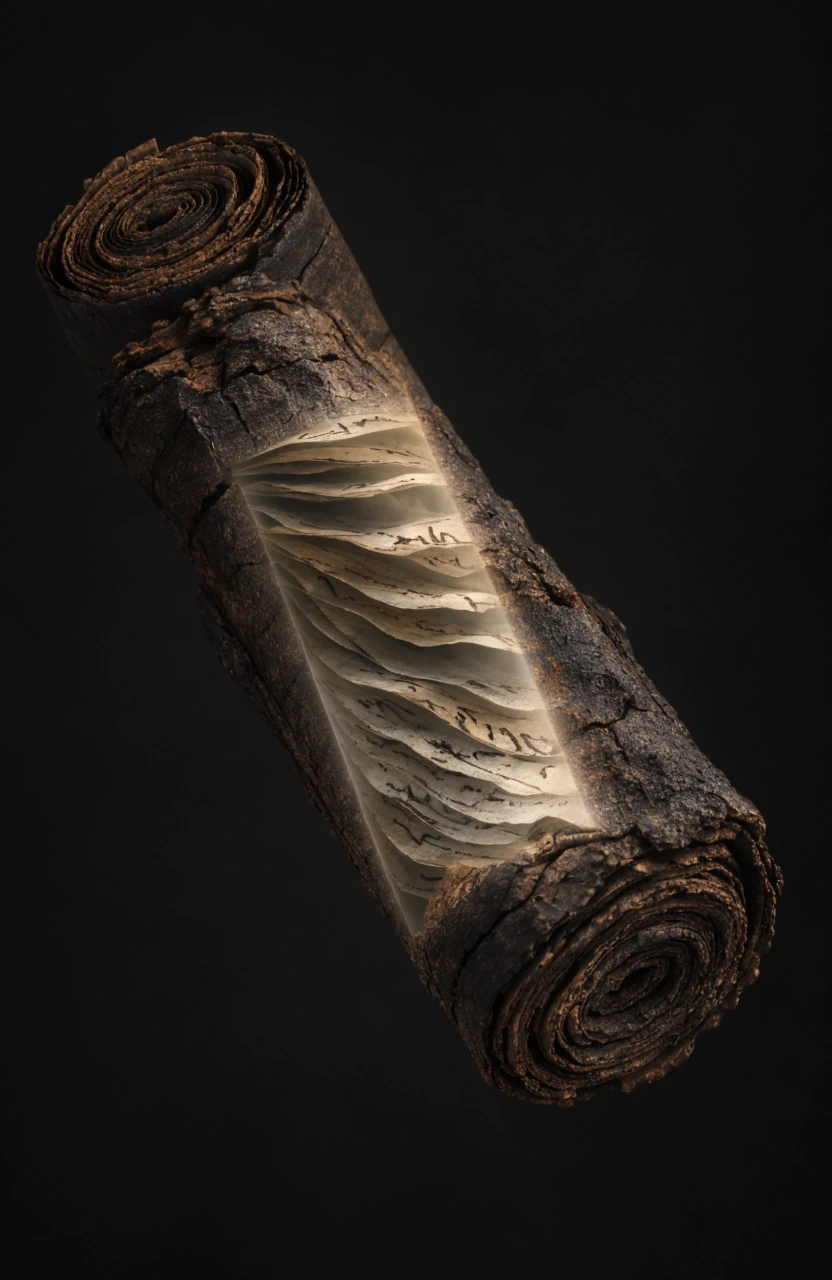
When Vesuvius erupted in AD 79, it buried a villa at Herculaneum containing a library of papyrus scrolls. Heat carbonized the rolls. Centuries later, excavators recovered objects so fragile that attempts to open them could break apart the very writing they hoped to read. Some scrolls were painstakingly opened and read; others remained too fragile to unroll safely. (Source: Kenneth Lapatin, Getty, 2019; Getty, “The Papyri”.)
A closed scroll normally promises that its contents are waiting for you. These made a more difficult offer: the writing might survive, provided you stopped trying to get at it.
The unopened rolls had survived as matter. Becoming books people could read was a separate achievement.
How to read a book that stays closed
The method begins with X-ray computed tomography, which records the scroll's interior in three dimensions. Researchers trace the folded, compressed papyrus surfaces through that volume, then flatten those surfaces digitally. The physical roll stays as it is. (Source: Parker and colleagues, 2019.)
Finding the page does not automatically reveal the writing. Carbon-based ink on carbonized papyrus gives little of the easy contrast an ordinary X-ray image might lead you to expect. In 2019, a team led by researchers at the University of Kentucky showed that subtle signals associated with the ink could nevertheless be detected in the scans using machine learning. (Source: Parker and colleagues, 2019.)
One early clue was a cracked texture associated with ink. Casey Handmer spotted the pattern; Luke Farritor used examples to train a model that revealed more traces. The breakthrough announced in October 2023 included a word translated as “purple.” A color had become legible inside a blackened roll. (Source: Vesuvius Challenge, October 2023.)
Specialists in ancient papyrus examined the resulting images and read the letters. Scanning, software, and scholarship each supplied something the others could not. (Source: Vesuvius Challenge, October 2023.)
After all that, someone has an opinion about food
Among the passages announced in February 2024 was an argument about pleasure. The researchers' preliminary reading described an author considering whether scarce goods, including food, necessarily give more pleasure than plentiful ones. The answer appeared to be no. (Source: Vesuvius Challenge, February 2024.)
We can put that old question on a present-day table. Imagine serving the same dish twice: once as something difficult to obtain, once as something always available. Which part of its appeal belongs to the food, and which part belongs to the story of getting it?
The passage gives us an older participant in that argument. Someone had already found the distinction worth thinking through.
The extraordinary effort of recovering the text also tells us nothing about whether its author was right. We can be delighted that an argument survived and still disagree with it. Reading restores that possibility.
Keep the uncertain letters
The First Letters announcement includes an image with colored boxes recording scholars' confidence in individual letters. Agreement is visible. So is hesitation. You do not need to read Greek to see that getting a word back involves judgments, not just a machine producing a clean answer. (Source: Vesuvius Challenge, October 2023.)
The 2024 project report describes checks on the ink images: independently reproduced code, comparisons between different models, and analysis of small patches of scan data. Those models were detecting ink rather than predicting sequences of Greek words. The checks strengthen the connection between the image and the object; they do not make every letter or interpretation certain. (Source: Vesuvius Challenge, February 2024.)
Imagine filling every remaining gap with the most plausible continuation. That could produce a smoother page while making the discovery harder to assess. A reconstruction can be useful if its additions remain visible. For a reader, a clearly marked gap can carry more information than a confident completion.
Enough of a voice to answer back
The scrolls make a useful distinction between information that has disappeared and information we cannot yet reach. Better instruments can change the second condition. They cannot guarantee recovery of a passage whose physical traces are gone.
They also cannot make one surviving library stand for an entire culture. However much becomes readable, it will still be a particular collection. Recovering its contents gives us more voices to consider while leaving other absences unresolved.
Preserving an unreadable object leaves room for someone to approach it differently. The scrolls give that otherwise abstract possibility a physical form: a book kept closed long enough for another way of reading to become possible.
For a closer look, compare the ink image and the scholars' confidence annotations in the First Letters report. What would you want to check before accepting a translation? (Source: Vesuvius Challenge, October 2023.)
Someone once thought an argument about pleasure was worth writing down. Nearly two thousand years later, we have enough of it to start disagreeing again.
Think with the idea.
Where would you leave a gap?
Imagine editing a recovered page. Several letters are uncertain, but the context suggests a fluent sentence. How would you show a reader the difference between surviving marks and your proposed completion?
A proposed restoration can help a reader when its status remains visible.Would the same food taste different?
Imagine the same dish offered as a rare treat and as something always available. Which part of its appeal might belong to the dish, and which to the circumstances? The ancient argument gives you a position to examine.
This is a thought experiment. The recovered passage is not experimental evidence about scarcity or enjoyment.