A Stimarium Dossier
One skull can wear very different faces
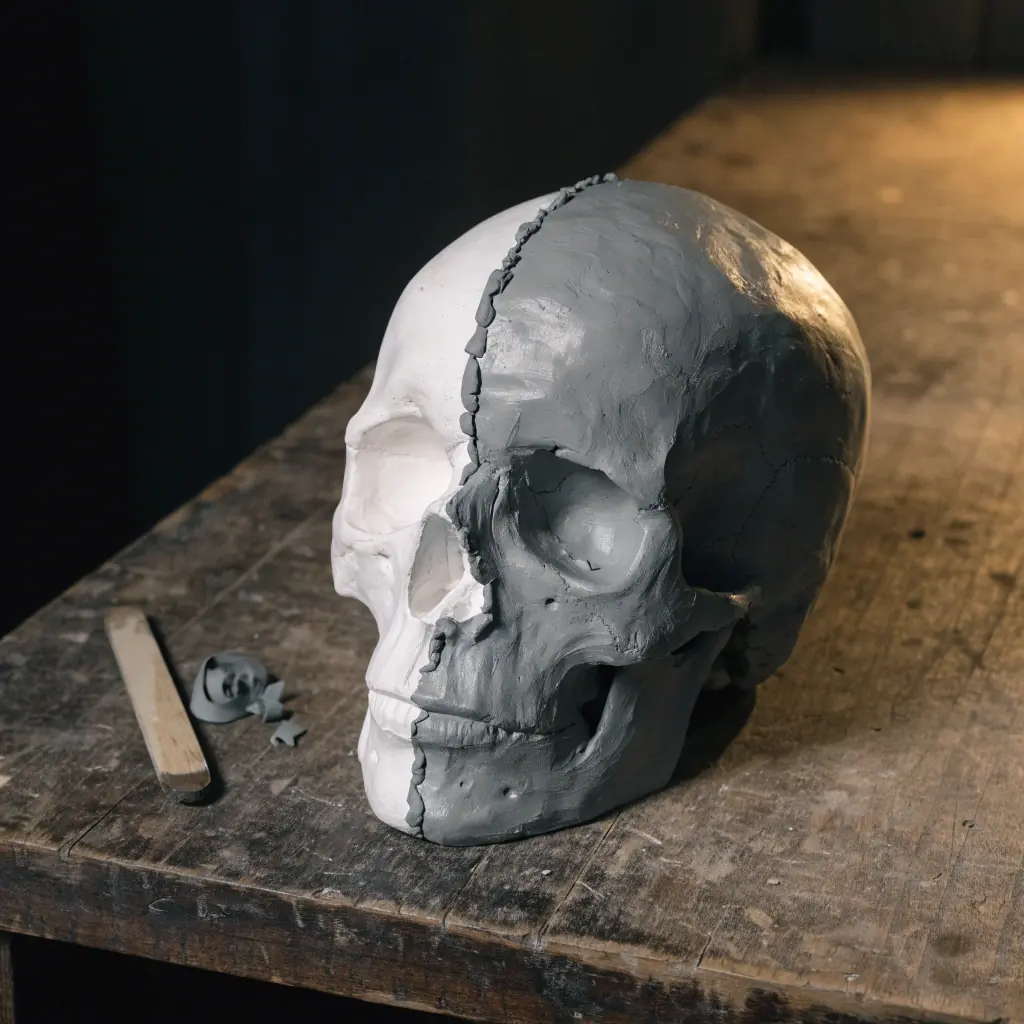
To rebuild the face of someone long dead, an artist lays clay or digital muscle and skin over the skull. The skull fixes the bones, but much of the nose, lips, skin and hair has to be estimated. Two faces built on the same skull can look like different people, because each maker fills those gaps differently.
What’s known, what’s not: Known, Our read, OpenCorrection, 22 October 2026: We had given average resemblance ratings for the two faces that we could not trace to the part of the study we read. The study's summary says the two faces received similar ratings, so we now say that. How we handle corrections
Can anyone recognize a face built on a skull?
In a test published in 2001, Carl Stephan and Maciej Henneberg gave four skulls faces using four accepted methods, sixteen reconstructions in all. Then 37 people tried to pick each skull's real owner from a set of ten photographs. [S01]
Only one of the sixteen faces was matched to the right person more often than chance would predict. Across the whole test, 403 of 592 attempts picked the wrong person. [S01]
The skull fixes the bones. Much of the rest, including eye color, hair and the exact shape of the nose and lips, has to be estimated from averages and experience. [S03]
Only one of the sixteen faces was matched to the right person more often than chance would predict.
What the sculptor knows ends up in the clay
In a 2006 study, Stephan and R. S. Arthur compared two faces built on casts of the same skull. An experienced practitioner who could see a photograph of the person made one. A novice working blind made the other. [S02]
The two faces looked clearly different. In a recognition test, people picked out the first almost without exception and the second no better than chance. Yet the two faces received similar resemblance ratings. [S02]
We think this shows why resemblance ratings need careful handling: a face can receive a favorable score and still fail a recognition test. The comparison also changed the practitioner's experience and access to a photograph together, so it cannot isolate the effect of either one. [S02]
The same skeleton, given two different skins
Cheddar Man is Britain's oldest nearly complete skeleton, about 10,000 years old. [S05]
A 1998 reconstruction from the University of Manchester gave him white skin, brown hair and brown eyes. At the time, researchers assumed that paler skin had spread in Europe long before he lived. [S06, S05]
In 2018 researchers sequenced his genome, reading the order of the chemical letters in his DNA. They found he most likely had blue or green eyes, dark brown or black hair, and dark or dark-to-black skin, and a new model was made to match. [S04, S05]
The new face is also a reconstruction. Skin color predicted from DNA is a probability, and the team reported it with that hedge: "most likely". Between 1998 and 2018 the skeleton stayed the same and the assumptions changed. [S04]
Between 1998 and 2018 the skeleton stayed the same and the assumptions changed.
Extinct relatives with many faces
The problem grows with distance. A 2021 review examined reconstructions of extinct human relatives, including markedly different faces made from the same fossil specimens. [S07]
The authors argued that unreliable soft-tissue estimates and interpretation of the evidence likely contributed to this variation, and proposed closer use of measurements and collaboration between artists and scientists. [S07]
Software inherits the same habit. In 2020 a face-sharpening tool called PULSE turned a pixelated photo of Barack Obama into the face of a white man. Its creators said it more often produced white features, a bias most likely inherited from the faces it was trained on. [S08]
A rough copy can still carry the person
Some reconstructions do carry the person. Caroline Wilkinson's 2010 review cites blind tests in which reconstructions were picked out of a set of faces 44 percent of the time against a chance rate of 10 percent, and 71 percent against 20 percent. [S03]
Wilkinson stresses that a reconstruction is a tool for recognition, not identification. It produces names to check, and DNA or dental records settle who someone was. [S03]
Every reconstructed face has two authors: the person whose skull it is, and the people who filled in the rest. When you look at one, ask how much of each you are seeing.
Every reconstructed face has two authors: the person whose skull it is, and the people who filled in the rest.
Think with the idea.
Take me sideways
A police sketch drawn from a witness's memory shows the witness's memory as well as the suspect. A face built on a skull carries its sculptor the same way.
Analogy.Challenge it
The 2001 test used four skulls and older methods; later blind tests report better recognition. Skin color predicted from a genome is a probability.
Scope warning.Trace it
Set it beside the AI twins built from people's survey answers. A copy of a person made from partial data fills its gaps with averages, in clay or in code.
Cross-domain synthesis, not a finding of the cited studies.Take it with you
When a museum or documentary shows you a reconstructed face, ask what came from the bones, what came from DNA, and what came from the artist.
Reflection prompt.What’s known, what’s not
↑ Back to where you were- In a 2001 test, only 1 of 16 faces built on skulls was matched to the right person above chance. [S01]
- On the same skull, a maker given the person’s photo produced a recognized face; a novice without it did not. [S02]
- Cheddar Man's 1998 reconstruction had white skin; his DNA, read in 2018, pointed to dark or dark-to-black skin. [S04, S06]
We think a reconstructed face carries choices made by its maker alongside evidence from the skull. Blind recognition tests and comparisons with a known face can help us assess how much those choices affect the result.
- Could estimates of skin, fat and muscle from measurement and DNA make reconstructions reliably recognizable?
- Which of today's reconstructions will look as dated as the 1998 Cheddar Man?
What the three labels meanClose explanations
Known marks what the cited evidence directly supports, including what named researchers argue.
Our read is Stimarium’s own interpretation of that evidence.
Open marks a question the cited evidence can’t answer yet, or a possibility we are raising ourselves.