A Stimarium Dossier
The Morning Tax
Each morning, a thin mat of microbes starts making oxygen, but the oxygen has to build up inside the mat before any escapes into the water. In a 2021 study's models, a longer day lets more of it out from the same photosynthesis. The study asks whether Earth's lengthening days helped fill the air. Geophysicists still disagree about how the day lengthened.
What’s known, what’s not: Known, Our read, OpenFirst pass, about a minute
The idea in about a minute. Same evidence rules.
Earth's day has not always been 24 hours long. The Moon's pull has been slowing the planet's spin for billions of years, so the days of the deep past were shorter.
Now picture a mat of microbes spread across a lake floor, a living layer over the sediment. At sunrise it starts making oxygen, but none of that oxygen leaves right away. It first has to build up inside the mat before it can spread into the water above. That wait costs the mat part of every morning. Call it the morning tax.
The tax stays the same on a longer day, but more daylight is left after it is paid. In the study's computer models, a mat doing the same amount of photosynthesis released more oxygen as the day grew longer.
Real measurements tell a narrower story. One mat from a sinkhole in Lake Huron, studied under controlled day lengths and specific chemical conditions, went from taking in more oxygen than it released to releasing more than it took in. That happened only past certain day lengths. The change was more abrupt than the models’ smooth climb. That is one mat under the conditions tested, not a rule for every mat or every planet.
The idea also leans on a clock nobody has fully read. Geophysicists still disagree about how Earth's day length changed across its history.
The full Dossier explains the delay in oxygen export, sets the two uncertain histories side by side, and marks where the evidence stops.
Maybe: the 2021 study proposes that as Earth's days lengthened over deep time, this effect helped fill the air with oxygen. It is a proposal, not a finding.
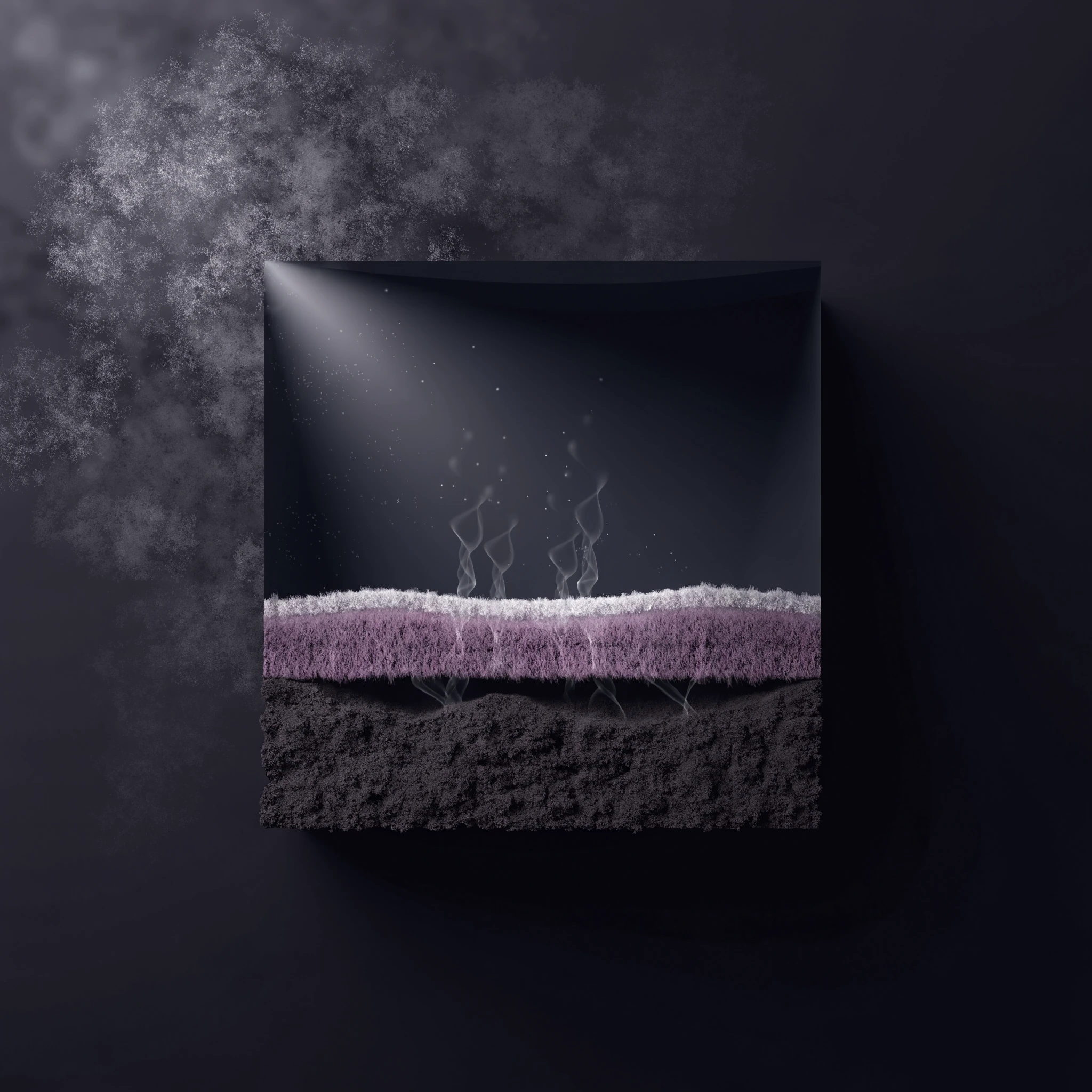
When the length of the day becomes an input
At dawn, a mat of microbes on a lake floor starts making oxygen. A 2021 study in Nature Geoscience asks whether more of that oxygen escapes when the day is longer. Earth's days have lengthened over geological time as the Moon's pull slowed its spin. [S01]
The setting is a microbial mat, a layered community of organisms living at a sediment–water boundary. Cyanobacteria are bacteria that capture energy from sunlight, and they make oxygen when they photosynthesize. But making oxygen and exporting oxygen are not the same event. Gas and dissolved chemicals have to move through the mat and across its boundary. A day can end while part of the day's production is still inside the community.
In the study's models, total photosynthesis is held constant while the length of the day changes. With a longer day, more oxygen leaves the mats each day and more of their organic matter ends up buried. In the study's global model, buried carbon is a source of oxygen for the air. The microbes do not have to work harder. The day length changes how much of what they make leaves the mat for good. [S01]
That is the paper's strongest idea, and it is smaller than its planetary conclusion. A delay at the scale of a mat is measured. The proposal that this delay helped oxygenate Earth's atmosphere is a scaling exercise with explicit assumptions. A local effect can be real before its global importance is established.
A day can end while part of the day's production is still inside the community.
Why dawn costs something
Inside a mat, oxygen production and oxygen release peak at different times. As photosynthesis raises the oxygen concentration, the gas spreads through the mat from areas of higher concentration to lower concentration, a process called diffusion. Release peaks after production. In Klatt and colleagues’ models, the lag takes up a smaller share of a longer day. [S01]
On a short day, a fixed delay takes up a large share of the available cycle. On a long day, the same delay is a smaller fraction. The microbes have not necessarily made more oxygen per unit of photosynthetic effort; more of what they made has had time to leave before the next darkness changes the chemical conditions. In the model, more organic carbon can also leave the mat and become buried, contributing to a longer-lasting change in the global oxygen budget.
The “tax” is the time oxygen takes to leave the mat. It names a fixed delay per cycle; it does not imply a collector or a universal day length at which all mats begin to release more oxygen than they use.
The simple diffusion-only model therefore gives a smooth result: export rises as the day gets longer. The study also allows metabolism and community behavior to amplify the physical effect. Those additions make a biological system less like a passive slab, but they do not change where the evidence stops. A model of a general lag is not a measurement of every ancient mat. [S01]
A sinkhole in Lake Huron
To examine the delay in a living community, the study turns to the Middle Island Sinkhole in Lake Huron, about twenty-four metres down. The water is low in oxygen and rich in sulfur. Purple cyanobacteria and white sulfur-oxidizing bacteria, which draw energy from sulfur compounds, trade vertical positions through the daily cycle, making the site a modern analog for a chemical environment unlike an ordinary sunlit surface. [S02]
The mat is a modern community that stands in for ancient ones. Researchers can watch production, concentration and export interact there under controlled day lengths. Diffusion alone produces a longer-day effect in the model. Metabolic switching and the behavior of the community amplify what the physical lag starts. [S01]
The reported thresholds belong to this mat under the stated conditions. Simulated days shorter than twelve hours were net oxygen sinks. Net export appeared at sixteen hours and longer. At twenty-one hours and twenty-four hours, export was roughly two times and three times the sixteen-hour value. These measurements describe one community in a low-oxygen experimental setting with no sulfide, a dissolved sulfur compound. Applying them to other mats or to a whole planet requires further evidence. [S01]
This is also where two shapes must stay separate. The diffusion-only model rises smoothly with day length. One mat from the Middle Island Sinkhole shows a more abrupt switch. A community can add a threshold to a physical trend without turning that threshold into a law of biology or geology.
The sinkhole's value is that it makes a hidden timing problem visible. Oxygen can be produced and still fail to cross the boundary on the timescale that matters. The modern mat shows a local delay whose planetary role remains uncertain.
The modern mat shows a local delay whose planetary role remains uncertain.
From a mat to a planet
The planetary step begins with a history of Earth's day length associated with Bartlett and Stevenson (2016), then places the delay in oxygen export from mats inside a simplified global oxygen budget modeled on COPSE, a model of how Earth's carbon, oxygen, phosphorus and sulfur cycles changed over hundreds of millions of years. It is a scenario exercise with a simplified model, and it does not measure how much of the ancient seafloor mats covered. It asks: if that delay operated across enough seafloor and lakebed habitat, could its effect be large enough to matter? [S03] [S01]
In the authors' scenarios, mats covering about 1.5 to 3.7 percent of today's ocean area, plus 5 percent of land, can produce an oxygen difference large enough to matter in the budget. The authors set these coverage figures as test scenarios. No one knows how much of the seafloor mats covered in the Precambrian, the span of Earth’s history before about 539 million years ago. The result tests whether the proposal is possible; it cannot establish the ancient extent of mats or their actual contribution. [S01]
The proposal is strongest when it keeps its caveats in view. The share of buried carbon that came from mats on the seafloor (benthic burial) is “highly uncertain.” A precise reconstruction of Earth’s rotation rate in the Precambrian is, in the authors' words, “currently beyond reach.” The paper calls its conclusion a “possible link,” not a demonstrated planetary cause. A longer day can make the delay in oxygen export from mats more consequential in a budget without proving that it drove the Great Oxidation Event or the later Neoproterozoic Oxygenation Event.
There is another route in the newer literature. Capirala and Olson (2026) propose that slower rotation could affect oxygen through stronger wind-driven upwelling, in which deep water rises toward the surface. That is a second pathway, not a replication check on Klatt's proposed oxygen-export effect in mats. It widens the question to what a planet's rotation can do to its atmosphere, but it does not confirm the answer for mats. [S08]
So the planetary link is a possibility built on a measured local delay and uncertain assumptions about area, burial and history. It does not show that the link happened, that it was the main driver, or that other oxygen sources and sinks stopped mattering.
We don't know how long the days were
The hypothesis places two histories beside each other. Oxygen did not rise as a smooth ramp. The geological record contains a Great Oxidation Event, roughly 2.4–2.1 billion years ago, and a later Neoproterozoic Oxygenation Event, roughly 0.8–0.54 billion years ago. If day length also moved through steps or a long pause, the visual fit is tempting.
But the day-length staircase is contested. Mitchell and Kirscher (2023) interpret the record as a stall near nineteen hours for about a billion years, around 2–1 billion years ago. [S04] Wu and colleagues (2023) model a thermal-tide lock that, in their summary, held the day near 19.5 hours from roughly 2.2 to 0.6 billion years ago, a state in which tides raised in the air by the Sun's daily heating sped Earth's spin about as much as the Moon's pull slowed it. [S05] Farhat and colleagues (2024), using a different model, find such an equilibrium unlikely and question some of the day-length data drawn from stromatolites, layered rocks built by microbes. [S06] Zhou and colleagues (2024) see no sign of a stall in their rock-layer record and raise a possible ocean-tide resonance around 1.5 to 1.3 billion years ago, a stretch when the tides' rhythm matched the oceans' natural sloshing, so the tides grew stronger and slowed Earth's spin faster. [S07]
These are competing reconstructions of Earth’s day length. The proposed stall might help explain the long interval between the oxygenation events if it survives the evidence test. If it does not, the timing fit loosens. The history of Earth's rotation has to be established in its own right before it can be laid beside the oxygen record.
There is a second fog. We do not know how much early carbon burial came from mats on the seafloor and how much from plankton in open water. The authors describe that split as highly uncertain. Plankton do not sit at a sediment boundary in the same way, so their oxygen does not face the same slow seep out. If plankton did most of the relevant work, the mats' oxygen effect would matter less for the whole planet, even if the Middle Island Sinkhole result from Lake Huron and the model remain sound. [S01]
That is why the argument should not be written as “the days got longer, so the air filled.” The proposed connection depends on two uncertain histories: atmospheric oxygen and Earth’s rotation. The apparent alignment of these histories is suggestive, but neither is precise enough to establish the link.
The uncertainty tells the reader where the measured local effect ends and the historical reconstruction begins. A better day-length record could strengthen the link, weaken it, or show that the relevant change happened on a different schedule altogether.
The apparent alignment of these histories is suggestive, but neither is precise enough to establish the link.
Spin as a variable for other worlds
If the length of daylight on a planet changes how much oxygen leaves a microbial seafloor, rotation belongs on the list of variables that can shape an atmosphere. That extension is ours. We know of no published work that applies Klatt's proposal to planets around other stars or to the search for signs of life on them. Tidally locked worlds, which keep the same side facing their star, would break the ordinary sunrise-and-sunset frame in ways that make the analogy especially uncertain.
We can ask the same question of other systems: when a cycle sets the conditions for exchange, does its duration change how much crosses the boundary? This is a question for exploration, rather than an additional claim about Earth’s oxygen history.
Output depends on how time is sliced
The portable idea is a fixed cost per cycle. A batch job, a set of computer tasks run together, spends time starting up before it can process the batch. Switching a computer from one task to another costs time, and an engine has to warm up. Put the same overhead inside a short cycle and it occupies a large share; spread it across a longer cycle and the fraction spent producing output can rise.
A database is not a microbial mat, and fatigue, staleness and other costs can make a longer human work block worse rather than better. Still, the comparison points to a second measure: how much of a system's work crosses the boundary before the cycle closes, as well as how much work it does.
That is what the Moon may have done to the history of air: it changed the schedule under which living chemistry had to operate. Whether that scheduling effect mattered at planetary scale depends on the oxygen-export effect in mats, the share of burial, the day-length history and the alternatives. Evidence is still being gathered from tidal layers in rock.
Think with the idea.
Sideways: where else is there a morning tax?
Look for a system with a fixed start-up cost per cycle: batching database writes, a long work block, or an engine warming up. When would a longer cycle leave more time for useful output?
The resemblance is structural. The mat’s cost is a physical diffusion lag. In people and machines, longer cycles add costs of their own, such as fatigue, drift and delayed feedback, that the mat model doesn’t include.Challenge: what if plankton did most of the work?
Open-water plankton don’t face the same diffusion bottleneck at a sediment surface. If they dominated oxygen-relevant carbon burial at the key times, day length would matter much less for the planet, even if the oxygen-export effect in mats is exactly right.
The mats-versus-plankton share is unresolved. The authors call it “highly uncertain” and treat 20–50 percent mat burial as a scenario, not a finding.Pattern: what gets made and what gets out
Two mats with identical photosynthesis can export different amounts of oxygen. Where else do we judge a system by its effort when the result depends on timing: productivity metrics, carbon accounting, how a body takes up nutrients?
In this study, the comparison at identical photosynthesis comes from the models. The Lake Huron lab runs show what day length did to one mat under stated conditions, not a controlled test at equal production.Break the analogy: the “tax” isn’t a tax
Nothing is collected, and no one receives anything. Oxygen isn’t taken; it’s delayed, and part of each day’s output never makes it out in time to count. “Tax” is a teaching handle for a lag.
Keep the metaphor while it helps you picture the delay. Drop it the moment it suggests intent, a collector, or a cost someone could avoid by negotiating.Two clocks: what would settle it?
Dense, well-dated day-length estimates from tidal layers and cyclic sediments spanning 2.5 to 0.5 billion years ago would test whether a stall existed and when it ended. Independent mat experiments at different day lengths would test how widely the oxygen-export effect applies.
Even a perfect match in timing would be a correlation. Showing cause would still require the scaling assumptions about mat coverage, burial share and whether modern analogs apply to ancient mats.What’s known, what’s not
↑ Back to where you were- In computer models of microbial mats, a 24-hour day let more oxygen escape than a 12-hour day, with the same photosynthesis. [S01]
- A Lake Huron mat consumed net oxygen during simulated days shorter than 12 hours and exported it at 16 hours and longer. [S01]
- How Earth’s day lengthened is disputed: some argue it stalled near 19 hours for up to a billion years; others find that unlikely. [S04, S05, S06]
We think the lag is real and likely general to mats where oxygen seeps out slowly. The planetary link shows a possible cause of Earth’s oxygen rise, not a proven one.
- Was day length a major driver of Earth’s oxygen steps, beside volcanoes, tectonics, nutrients and evolving oxygen-making bacteria?
- Does a planet’s spin shape when oxygen appears on other worlds? That extension is ours.
What the three labels meanClose explanations
Known marks what the cited evidence directly supports, including what named researchers argue.
Our read is Stimarium’s own interpretation of that evidence.
Open marks a question the cited evidence can’t answer yet, or a possibility we are raising ourselves.